The skewness of the glottal airflow pulse determines the spectral properties of the generated voiced sound. When the excitation pulse is more skewed to the left, then the spectral tilt is more gradual. The skewness of the glottal pulse is usually described by the Speed Quotient (see section 7.1). In the electroglottographic signal the Speed Quotient (SQ) is defined as the ratio of rise time (increased contact ) to fall time (decreased contact), which leads to an inverted measure compared to the SQ's definition within the acoustic signal. This means that higher values for the SQ indicate more symmetrical EGG pulses. The SQ relates the rise time, which is defined as the time between the instant of glottal closure (the maximum of the EGG signal's derivative) and the moment at which the amplitude of the signal reaches 90% of the peak-to-peak amplitude, to the fall time (the time span between the 90% value of the peak-to-peak amplitude and the opening instant). The SQ is defined in eq. (16).
The values for the SQ that were computed for each EGG period of a vowel were statistically examined. The influence of the speaker's gender is significant (repeated measurements ANOVA with factor sex: F0(1,5242)=1326,6, p<0.0005). The EGG pulses produced by male subjects are more skewed, which is in line with acoustic studies (e.g. Claßen et al., 1996; Sluijter, 1995; Hanson, 1995).
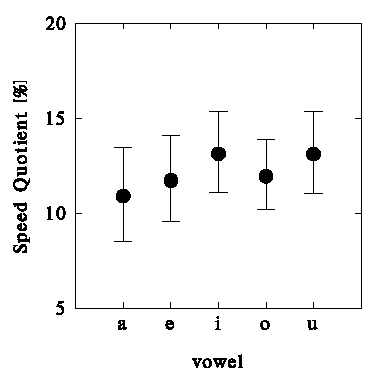
Fig.27 shows the dependence of the SQ on the vowel type. The SQ grows significantly with vowel height. This phenomenon can be explained by the interaction between vocal tract and larynx which involves a narrowed stricture above the glottis (Bickley & Stevens, 1986; Stevens, 1994:12) and the "tongue-pull" hypothesis (Maddieson, 1997:622-624). The higher vowels have a higher F0 than lower vowels because the higher position of the tongue results in increased tension of the vocal folds. This in turn influences the Speed Quotient.
The analysis within gender groups was done using the standardized values of the Speed Quotient.
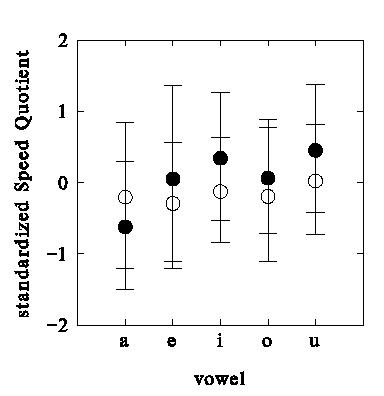
Within the female group the skewness of the EGG pulse depends on the measurment repetition, thus no definitive judgments can be made. Additionaly, certain factors interacts. For the male subjects, however, there are only two main effects that are either dependent on stress or on the vowel group. As depicted in Fig.28, the common tendency in both gender groups consists in the fact that the EGG pulses of stressed vowels are more symmetrical than their unstressed counterparts, i.e. that the SQ grows. However, this dependence is reversed for the vowel /a/. The effect of the stress factor is significant, but not very strong.
The effect of stress is thus in contrast to (except for /a/) the results of acoustic analyses (Claßen et al., 1996). The SQ in the EGG domain seems to be inverted compared to the acoustic measure. The EGG's skewness depends on the tenseness factor in a manner similar to stress. The pulses are more symmetrical for tense vowels (especially for stressed tokens) and again the vowel group /a/ deviates from the general tendency. These results are thus again inverted compared to those of the acoustic analysis.
| Figure 27. The dependence of the Speed Quotient on the vowel type. The standard deviations are plotted as whiskers. |
|
| Figure 28. The effect of stress on the standardized values of the Speed Quotient (SQ) for vowel groups. The unstressed tokens are marked with empty circles, the stressed tokens with full ones. The standard deviations are plotted as whiskers. |
 |
The observed reversal of pulse symmetry condition between the glottal airflow signal and the EGG signal, which may, at first, appear counter-intuitive, can be explained using a computer simulation of the phonation process (see chapter V). As a matter of fact, for moderate values of subglottal pressure (normal voice effort) both coefficients are inversely proportional to each other (see Fig.50)


