The recorded material was segmented and the vowels were isolated. The vowels were labelled manually and their boundaries were determined using the stability of the second formant as a criterion. For the whole vowel duration each pitch period was identified in the EGG waveform. Each of the EGG periods was segmented into phases as suggested in section 12. The entire segmentation process was performed automatically. Also the measurements of the characteristic parameters were done automatically[4] for each vowel. In the first step of the analysis the mean, the standard deviation as well as the minimum and maximum values were stored for all measured parameters. This was used to select the most suitable parameters describing the variation of the EGG signal. For the chosen parameters the values of each single EGG period of each vowel were collected and statistically analyzed.
In the examination of the acoustic data (Claßen et al. 1996) only one designated pitch period was subjected to an analysis (more accurately, an analysis was performed within a window which was centered around one pitch period of the vowel). The examination of the acoustical data was done manually and so it was impossible to investigate the complete vowel duration. The criteria for pitch period selection are given in Claßen (1996). The analysis of the whole vowel duration, which was performed automatically on the EGG signal here, seems to be more valuable (especially for the statistical evaluation of the results) than the analysis of only one pitch period.
To avoid the effects of aspiration due to the preceding /th/ which can create more breathy voice at the beginning of the vowel (Jessen, 1997:89-92), the first two EGG periods were excluded from further analysis. Also, the last period of the vowel's EGG was excluded to avoid the effects of the transition to /l/, i.e. changes in the position of the articulators which may in turn influence the phonation process.
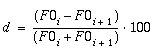
Some parameters additional to those presented in section 12 were used to describe the EGG waveform: fundamental frequency, relative duration difference between successive pitch periods (Marasek, 1995b), peak-to-peak amplitude of the EGG and crest factor (as defined in section 10.4). The relative duration difference between successive periods describes a short-time pitch perturbation (compare section 7.2) and is defined as (Gubrynowicz et al., 1980):
(18)
The mean and the standard deviation were made subject to statistical analysis (as dependent variables) for the following parameters:


